

Buying a private condominium or executive condominium in Singapore involves more than deciding how much a household can afford to spend. Buyers must also understand the financing regulations that determine how much they can borrow from a financial institution.
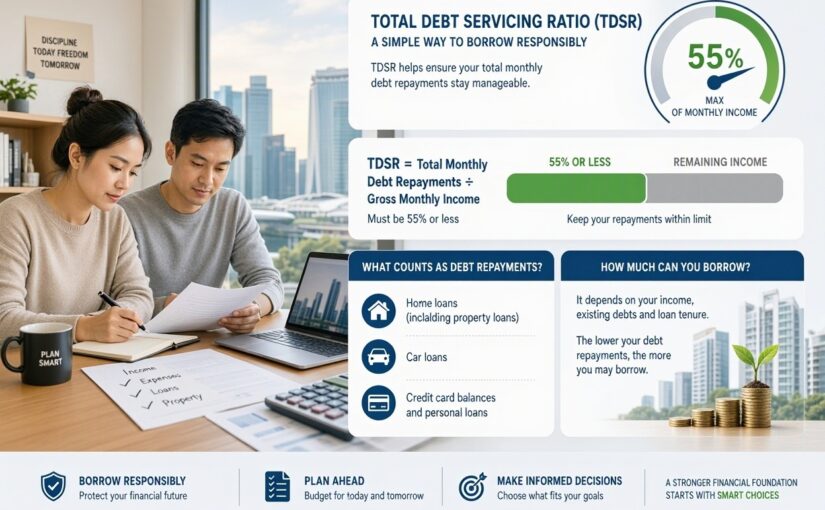
One important regulation is the Total Debt Servicing Ratio (TDSR). It establishes a limit on the proportion of a borrower’s gross monthly income that can be used to service outstanding debt obligations.
For prospective property owners, understanding TDSR early can prevent unrealistic budgeting and reduce the risk of committing to a property that exceeds their borrowing capacity.
1. What Is the Total Debt Servicing Ratio?
The TDSR is a property financing framework introduced by the Monetary Authority of Singapore (MAS). It limits the amount of a borrower’s gross monthly income that can be allocated towards monthly debt repayments.
Under the prevailing framework, the TDSR threshold is generally 55%.
This means that a borrower with a gross monthly income of S$10,000 would have a maximum monthly debt servicing capacity of S$5,500 under the TDSR calculation.
Importantly, this amount covers all relevant debt obligations rather than just the mortgage for the property being purchased.
Existing financial commitments, such as car loans, personal loans and credit facilities, may affect the amount available for a new housing loan.
The purpose of the framework is to encourage responsible borrowing and reduce the risk of households taking on excessive financial commitments.
2. Which Financial Commitments Are Included?
Buyers sometimes assume that their mortgage eligibility depends entirely on their monthly salary. However, financial institutions also consider existing debt obligations.
Depending on the applicable assessment rules, these may include:
- Existing housing loans.
- Car financing instalments.
- Personal loans.
- Credit card repayment obligations.
- Other recognised credit facilities.
For example, consider a household with a combined gross monthly income of S$12,000.
Using the general 55% TDSR threshold, its maximum monthly debt servicing capacity would be S$6,600.
If the household already has S$1,500 in monthly debt obligations, the remaining capacity for the proposed property loan would be approximately S$5,100.
This is a simplified illustration. Actual assessments depend on the financial institution’s calculations, applicable regulatory requirements and the borrower’s circumstances.
Buyers should therefore obtain a proper loan assessment rather than relying exclusively on their own calculations.
3. How Interest Rate Assumptions Affect Borrowing Capacity
Another important consideration is the interest rate used when assessing property loans.
Financial institutions do not necessarily calculate affordability using only the mortgage interest rate currently offered to the borrower.
For property loans, regulatory interest rate floors and applicable stress-testing assumptions are used to assess repayment capacity.
This approach helps determine whether borrowers could manage their commitments if interest rates increased.
Consequently, a household may discover that its approved loan amount is lower than expected, even when the advertised mortgage package appears affordable.
Buyers should also distinguish between the loan amount they qualify for and the amount they should comfortably borrow.
A household may technically qualify for a larger loan but prefer a smaller commitment to preserve savings for emergencies, education expenses and other financial priorities.
4. How TDSR Applies to Executive and Private Condominiums
TDSR is relevant when financing private residential property purchases, including private condominiums and applicable executive condominium transactions.
However, EC buyers should understand that another financing measure may also apply.
The Mortgage Servicing Ratio (MSR) generally limits monthly mortgage repayments to 30% of gross monthly income for relevant EC purchases.
This is different from TDSR, which considers broader debt obligations.
The distinction matters because an eligible EC buyer may need to satisfy both applicable financing requirements.
For instance, someone purchasing an EC directly from a developer should understand the applicable MSR and TDSR calculations before deciding on a suitable unit.
In northern Singapore, prospective buyers may come across developments such as Fablewoode Residences, a planned executive condominium along Sembawang Road in District 27.
The development is expected to comprise approximately 265 low-rise homes on a 99-year leasehold site. It is being developed by Oriental Pacific Development, with Canberra MRT approximately 0.5km away.
Understanding financing restrictions before assessing individual units can help prospective EC buyers establish a realistic purchasing budget.
5. Practical Ways to Improve Your Borrowing Position
Buyers who discover that their borrowing capacity is lower than expected can review their financial position before proceeding.
Consider these approaches:
Reduce existing debt commitments. Paying down outstanding personal or vehicle loans may improve the amount of income available for housing repayments.
Review credit facilities. Understand how existing credit obligations are assessed by financial institutions.
Increase available savings. A larger down payment may reduce the amount that needs to be borrowed, although buyers should retain sufficient emergency funds.
Consider a more affordable property. Selecting a smaller unit or a development with a lower purchase price can help keep monthly repayments manageable.
Avoid unnecessary financial commitments. Taking on additional loans before a property purchase may reduce borrowing capacity.
These steps should be considered alongside household income stability and future financial obligations.
6. A Practical Example for Private Property Buyers
Suppose a couple earns a combined gross monthly income of S$15,000.
Their general maximum TDSR allowance would be S$8,250 per month.
If their existing monthly debt obligations total S$1,250, the remaining amount available for the proposed mortgage under this simplified calculation would be S$7,000.
However, this does not mean they should automatically borrow the maximum permitted amount.
They should also account for property taxes, maintenance fees, insurance, utilities and other recurring expenses.
For example, Chencharu Central Residences is a planned private mixed-use condominium at Chencharu Close in Yishun, District 27. It is being developed by Gamuda Land, Evia Real Estate and Ho Lee Group, with up to approximately 875 homes planned.
Its proposed facilities include a hawker centre, bus interchange and retail components. Khatib MRT is approximately 0.45 to 0.49km away.
Although such development features may influence a buyer’s preferences, the eventual purchasing decision should remain within a financially sustainable budget. Launch pricing has not yet been confirmed.
Conclusion
The TDSR is an important consideration when purchasing residential property in Singapore. It helps regulate borrowing by ensuring that monthly debt obligations remain within an established proportion of gross income.
Prospective buyers should understand how existing loans, interest rate assumptions and other financing requirements affect their borrowing capacity. Before making a commitment, consult MAS guidelines and obtain an updated assessment from your financial institution.
A property purchase should support long-term financial stability rather than place unnecessary pressure on household cash flow.